
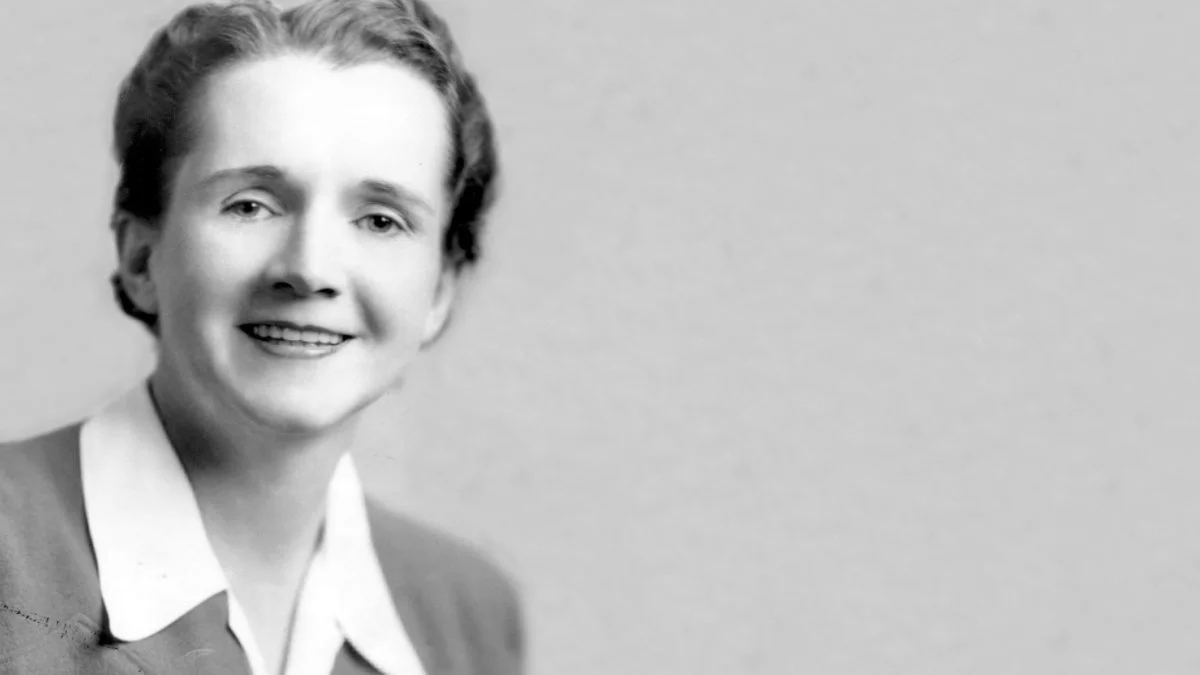
Have you heard of Rachel Carson?
I’m doing a poll.
So far, very few people I’ve asked have answered yes, which is astonishing to me! I grew up in her heyday, we had her books in our living room (my mom was a librarian), several of her titles were serialized in The New Yorker, and the world she wrote about was the subject of gorgeously photographed feature articles in Life Magazine. She’s been a hero of mine my whole life, and I want you to know about her, too!
Rachel Carson is credited with changing the course of history with her landmark best-seller Silent Spring, inspiring the environmental movement, popularizing ecology, and making the public aware that nature is vulnerable to human intervention.
And she did this as a woman in the early 1950’s and 1960’s.
Born in poverty in 1907 in a small town on the Allegheny River 10 miles north of Pittsburgh within view of a billowing black smokestack, she fell in love with the sea. She obtained an MA from Johns Hopkins in marine biology, abandoned her PhD studies due to the Depression, and got a job as a writer and editor for the U.S. Fish and Wildlife Service in Washington, DC.
She became one of the finest nature writers of the 20th century, a member of that rare club of authors who elegantly bring the world of science to life for us, in her case the sea and the Atlantic coastline.
She wrote 4 exquisitely written, best-selling books Under the Sea-Wind, 1941; The Sea Around Us, winner of the National Book Award in 1952 (and ever-present in my family’s living room); The Edge of the Sea, 1955; and Silent Spring, published in September 1962 after being serialized in The New Yorker the previous June.
Silent Spring sold more than 2 million copies, aroused international awareness and enraged the chemical industry, making the powerful case that if humankind poisoned nature, nature would in turn poison humankind. She was viciously attacked by industry representatives, who questioned not only her integrity but her sanity.
Carson was well prepared. Silent Spring included 50 pages of what was essentially a legal brief, with careful notes and prominent experts who had read and approved the manuscript. Leading scientists defended her. President John F. Kennedy ordered the President’s Science Advisory Committee to examine issues raised by the book, leading to a thorough vindication of both Carson and Silent Spring and eventually a ban on DDT.
In September 2012, 50 years after the publication of Silent Spring, The New York Times published the article, “How ‘Silent Spring’ Ignited the Environmental Movement.”
Illustration by Valero Doval
From the article:
“On June 4, 1963, less than a year after the controversial environmental classic ‘Silent Spring’ was published, its author, Rachel Carson, testified before a Senate subcommittee on pesticides. She was 56 and dying of breast cancer. She told almost no one. She’d already survived a radical mastectomy. Her pelvis was so riddled with fractures that it was nearly impossible for her to walk to her seat at the wooden table before the Congressional panel. To hide her baldness, she wore a dark brown wig.
‘Every once in a while in the history of mankind, a book has appeared which has substantially altered the course of history,’ Senator Ernest Gruening, a Democrat from Alaska, told Carson at the time.”
One other biographical note: she became her family’s breadwinner when her father died in 1935. At age of 28, she began caring for her mother and 2 sisters and eventually her nephew, Roger, until her own death. Her accomplishments are astounding to me.
To learn more about Rachel Carson’s courageous life and legacy, read her books, my friend Linda Lear’s masterful biography, Rachel Carson: Witness for Nature and The Story of Silent Spring on the NRDC website which briefly explains Carson’s profound contributions to the environmental movement.
Rachel Carson, 1907 – 1964. My hero!